In a compact space, this can dramatically increase how much food you grow without needing more land. There are a few ways to do succession planting, and in a small garden you’ll often combine them.
1. Staggered sowing (same crop, different times)
Rather than planting all your lettuce in one go, you sow a small batch every 2–3 weeks. That way, instead of a glut followed by nothing, you get a steady supply.
This works really well for quick crops like Lettuce, radishes, spinach and spring onions. Sometimes I might plant more seeds than I need, but hold some back by not repotting them all at the same time. This slows down their growth by a few weeks or more until I have space, and means I harvest longer.
2. Follow-on planting (different crops in the same space)
As soon as one crop finishes, you replace it with another. Timing is key here. An example is radishes first in early spring, followed by bush beans in late spring. In late summer I will plant spinach or rocket. That is 3 crops in one container. The soil is always working and not left bare.
3. Interplanting (overlapping crops)
This is where you plant a fast-growing crop alongside a slower one so that they share the same space briefly. I tend to do this with radishes and carrots.
The radishes are harvested before the carrots need the space.
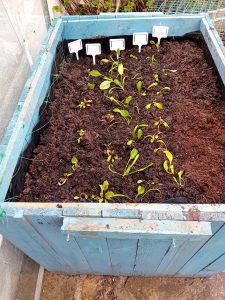
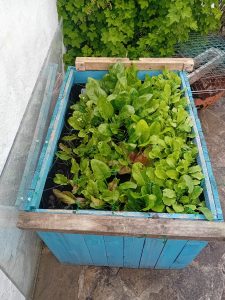
This is the same box near the end of April, about 6 weeks later. I am already harvesting spinach, and a bit of lettuce from here. The glass is left off now. My radishes will be a couple more weeks. Beetroots, spring onions and carrots are also in there and will grow into the space. There should be room to plant some dwarf beans. I plant crops closer than advised but they always grow well. We just harvest every other plant to make room for things like beetroot to expand, and eat some young. I get regular food this way.
For a limited space and small garden it is important to plan.
I follow the following principles.
Know your frost dates (especially in places like the UK with variable weather). I start crops off early in my conservatory or greenhouse and put them outside when the risk of frost has passed. I also grow some crops early in raised boxes under a recycled double glazed window. Both these thing extend my growing season.
Track “days to maturity” on seed packets and keep dates of when things were sown and when they will be ready to harvest.
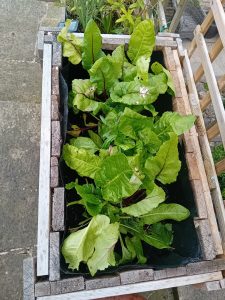
Have seedlings ready so that you can replant immediately after harvesting. I sow lettuce every 6 weeks, and beetroot 3 times a year. These beetroot gave me salad leaves all winter as they were grown under glass. I am leaving them to see if they produce bigger roots, or seeds, but already have beans planted in the box to climb the trellis.
Think of your garden in terms of time slots, not just beds.
Crop rotation
Although I am not as strict about rotating my crops as I was when I had an allotment, it is still important not to plant the exact same type of crop in the same spot repeatedly. A system I use is following leafy crops with fruiting ones (like tomatoes or beans). Root crops are planted after that.
This helps maintain soil health and reduces pests. I don’t stick to it religiously as sometimes crops last longer than you expect, or don’t do as well as you hoped.
The following is an example. I do this even in pots and small beds.
March–April: spinach + radishes
May–June: courgettes or dwarf beans
August–September: lettuce or pak choi
That’s three harvest cycles from one patch. Sometimes I even get 4 if I have planted things in February. The over winter beetroots were my 4th crop in that box last year.
Common mistakes
Planting too much at once leads to waste unless you are good at preserving or have a lot of beds.
Forgetting to replant quickly, or not having the seedlings ready. This leaves empty, wasted soil.
Ignoring seasonal limits. Some crops just won’t perform outside their window, but they can be stretched a bit with a poly tunnel or under glass. I stretch my potato season into winter by putting the buckets into the greenhouse and wrapping them in bubble wrap. I don’t get as many potatoes in those buckets as those planted in spring, but it still provides me with extra food.
Why it’s perfect for small spaces?
Succession planting turns a small garden into a high-efficiency system. Instead of thinking “I only have space for 5 plants,” you start thinking “how many crops can pass through this space in a year?” when ever I see a little space I will plant something, even if it is a herb or a flower.
Successional planting is hard work as you are sowing and planting regularly, but it turns a small growing area into a real victory garden. I used to have 2 big allotments, but my gardens at home provide me with more food and a wider variety of crops than they ever did. Do you use successional planting?
Other gardening blogs you may find interesting




Thanks Toni, that’s a really helpful article
Good. Thanks for your lovely feedback
Hi Toni
I’ve never been good at successional planting, but am trying hard this year.
Great article, thank you.
It has taken me years to build up the skills. Start small and easy.
As a fairly new gardener, I find this inspiring
Good. I hope that you enjoy growing this year. Every year it will get easier and you will feel more confident
You’ve inspired me so much Toni since I found your FB group. I’m still in the full time work space so don’t have a great deal of time unfortunately, but I’m getting out earlier in the morning now, and having a few minutes in the garden at each end of the day to try to get planting and growing some of my own food. I also went foraging, and whilst I didn’t find any wild garlic I did find garlic mustard so it was a definite win! Thank you ☺️
Brilliant. That is so lovely to hear. Small changes make a difference. I don’t like garlic mustard much. What did you do with it?